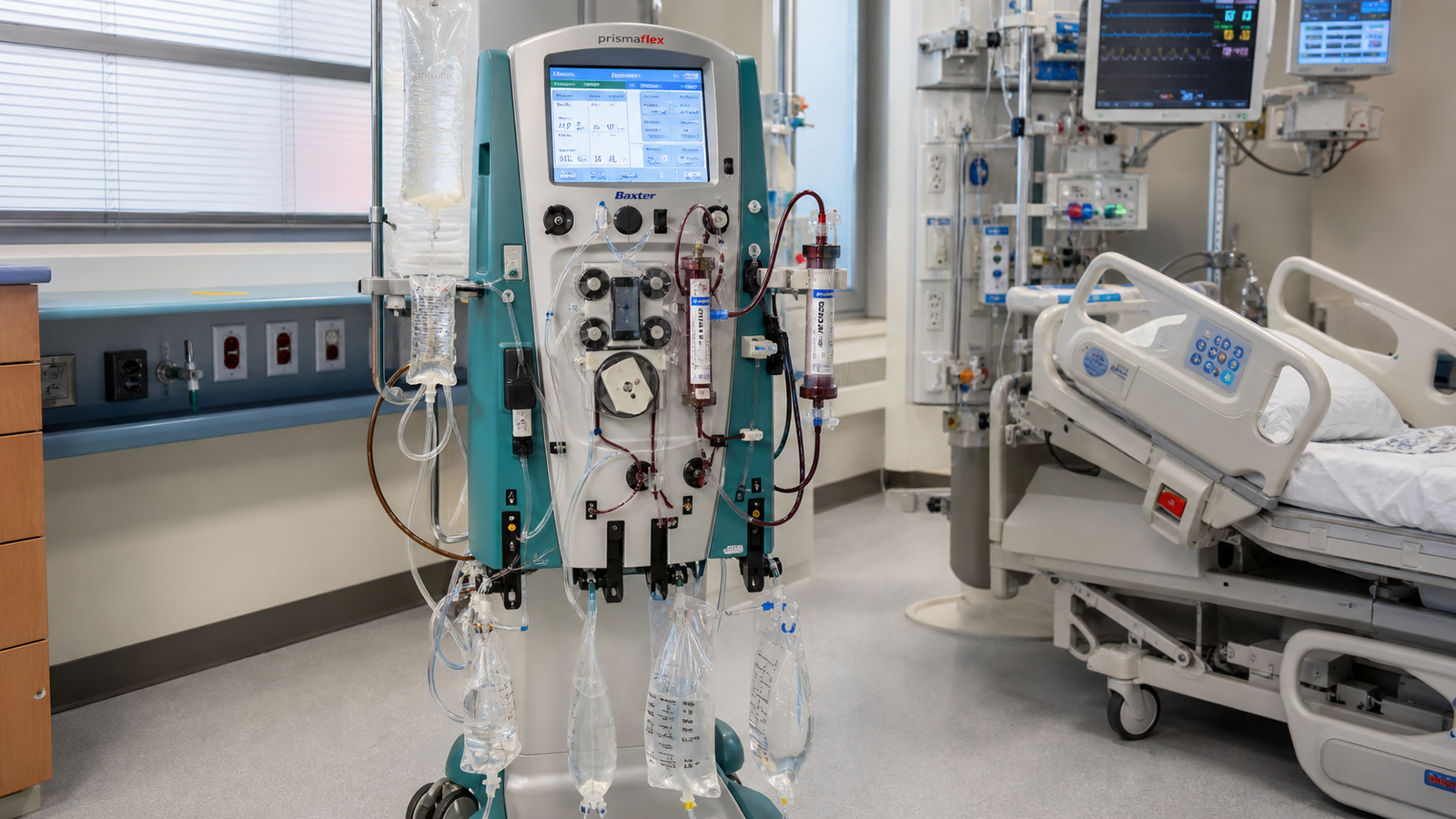
CRRT Nephrology – Patient & Family Education
1. What is CRRT?
CRRT stands for Continuous Renal Replacement Therapy. It is a form of extracorporeal kidney replacement therapy used mainly in critically ill patients with acute kidney injury.
Blood is continuously circulated through a specialised semipermeable membrane, where waste products and excess fluid are removed. Unlike conventional intermittent haemodialysis, CRRT provides this clearance continuously and at a much slower rate.
2. How is CRRT different from conventional haemodialysis?
The fundamental difference is not that CRRT is a completely different form of dialysis. Both use a semipermeable membrane to remove solutes and fluid from blood. The major difference is how the treatment is delivered.
Conventional haemodialysis generally provides relatively rapid solute and fluid removal over a limited treatment period, whereas CRRT provides slower, continuous clearance and fluid removal. This is particularly useful when a critically ill patient's circulation cannot tolerate rapid changes in fluid or solute concentration.
3. How does CRRT remove waste products?
There are two major mechanisms of solute removal:
Diffusion: Solutes move across the dialysis membrane from an area of higher concentration to an area of lower concentration. In CRRT, this is the main mechanism in continuous venovenous haemodialysis (CVVHD). Diffusion is particularly effective for small molecules such as urea and creatinine.
Convection: Water is pushed across the membrane by a pressure gradient, and dissolved solutes are carried with the water. This is called solvent drag. Convection is the principal mechanism in continuous venovenous haemofiltration (CVVH) and can remove a broader range of solute sizes depending on the membrane characteristics.
4. What is ultrafiltration?
Ultrafiltration is the movement of plasma water across the membrane because of a pressure difference across the membrane.
When solutes accompany this water across the membrane, the process contributes to convective clearance. Importantly, ultrafiltration can also be used specifically to remove excess body fluid, even when substantial solute removal is not required.
5. What are CVVH, CVVHD and CVVHDF?
These names describe the principal mechanism used for clearance:
- CVVH – Continuous Venovenous Haemofiltration: predominantly convection
- CVVHD – Continuous Venovenous Haemodialysis: predominantly diffusion
- CVVHDF – Continuous Venovenous Haemodiafiltration: combines diffusion + convection
CVVHD uses dialysate flowing on the opposite side of the membrane from blood. CVVH uses ultrafiltration with replacement fluid, while CVVHDF combines dialysate with convective filtration and replacement fluid.
6. Why is CRRT useful in critically ill patients?
Critically ill patients may have acute kidney injury together with low blood pressure, shock, fluid overload or severe disturbances of electrolytes and acid-base balance.
Because CRRT removes fluid and solutes gradually and continuously, it allows the medical team to make very precise adjustments to fluid balance and metabolic control. This slower approach can be advantageous in patients who may not tolerate the rapid fluid and solute shifts associated with intermittent haemodialysis.
7. Does CRRT remove only waste products?
No. CRRT can perform several functions of the kidneys.
Depending on the prescription, it can remove excess water, urea and other metabolic waste products, and help control potassium, acid-base balance and other electrolytes. The amount and rate of removal can be continuously adjusted according to the patient's clinical condition.
8. Does convection remove larger molecules than diffusion?
In general, yes. Diffusion is most efficient for smaller molecules and becomes progressively less efficient as molecular size increases.
Convective transport carries dissolved substances with water across the membrane, so removal is influenced mainly by the membrane's permeability and the size of its pores. This allows convection to remove some larger molecules more effectively than diffusion. However, the theoretical removal of larger inflammatory molecules does not automatically translate into better clinical outcomes.
9. Which type of CRRT is best?
There is no single CRRT modality that is universally best for every patient. CVVH, CVVHD and CVVHDF can all provide effective kidney replacement therapy.
The choice depends on the patient's clinical condition, fluid and metabolic requirements, available equipment, anticoagulation strategy and the experience of the treating team. Current evidence has not established a consistent patient-outcome advantage of one CRRT modality over another.
10. Is CRRT a permanent treatment?
Usually, CRRT is used as temporary kidney support during critical illness. In patients with acute kidney injury, the underlying illness may improve and kidney function may recover.
The treatment can therefore be reduced or stopped when the kidneys are able to maintain adequate fluid, electrolyte and metabolic balance. If kidney function does not recover sufficiently, another form of kidney replacement therapy may be required.
11. Does CRRT mean that the kidneys have permanently failed?
No. CRRT is often used because the kidneys have temporarily lost their ability to maintain normal fluid and metabolic balance during a severe illness.
Whether kidney function recovers depends primarily on the underlying cause and severity of kidney injury, the patient's overall condition and the extent of renal recovery. CRRT provides support while the medical team treats the underlying illness and assesses kidney recovery.
12. What is the main principle behind CRRT?
The simplest way to understand CRRT is:
- Diffusion removes solutes down a concentration gradient.
- Convection carries solutes with water across the membrane.
- Ultrafiltration removes water across the membrane.
- CRRT uses these principles continuously to provide controlled kidney support.
The treatment is individually prescribed and continuously adjusted according to the patient's clinical condition.